
Download the 2025 Focal Car Catalogue | Focal INSIDE Catalogue | Join our Mailing List!

What Are the Best IPS Panel Manufacturers in China?

Choosing an Ips Panel manufacturer in China involves more than comparing prices or screen sizes. Buyers need to understand what each supplier actually makes. Some companies produce LCD cells, while others assemble complete display modules using panels sourced elsewhere. That distinction affects customization, traceability, and technical support.

Details matter.

A useful comparison looks at viewing angles, color consistency, brightness, response time, and performance across the intended operating range. Backlight design, driver electronics, bonding methods, and calibration can all shape the finished display. A specification sheet is a starting point, not proof of real-world quality. Ask for samples, model-specific test data, and clear information about production capacity and quality controls. Then evaluate the display under conditions similar to its planned use, including ambient lighting and viewing distance.

Claims need proof.

This guide examines how to assess Chinese IPS panel manufacturers, what questions to ask, and which supplier details deserve closer attention. It also separates panel production from module integration, so comparisons remain fair. No single manufacturer is best for every project. A high-volume monitor buyer may value stable supply and consistent color, while an industrial equipment team may prioritize long product availability and dependable engineering support. Company profiles and certifications can change, so verify current details directly with each supplier. Even careful research has limits; sample performance may not represent every production batch. That is worth remembering.
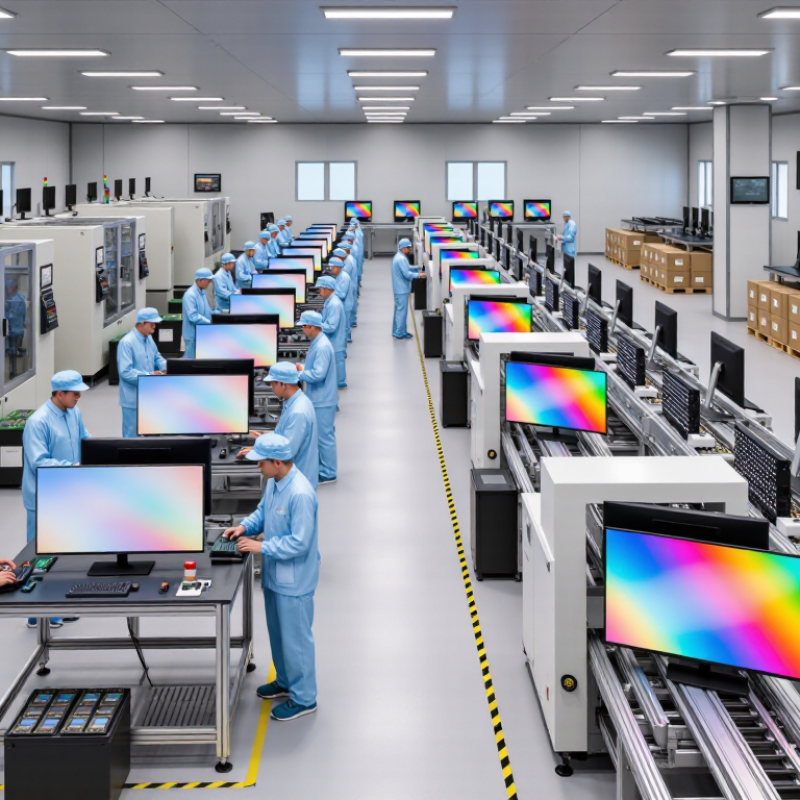
What Are the Best IPS Panel Manufacturers in China?

What IPS Panels Are and How They Work

An IPS panel is a type of LCD. Its liquid-crystal molecules rotate mainly within the plane of the glass, rather than tilting toward the viewer. Voltage changes their orientation, controlling how much light passes through each pixel’s color filters. A backlight supplies the light; IPS pixels do not emit it themselves. This structure helps preserve color and contrast when viewers move off-center, which is useful for shared screens and wide desks.

Many commercial IPS specifications quote 178° horizontal and vertical viewing angles. Treat that as a nominal figure, not a guarantee of identical image quality across the entire range. The International Committee for Display Metrology’s Information Display Measurements Standard provides methods for measuring display properties, including viewing-angle performance. Real results still depend on the test conditions and the panel’s implementation. That matters. At an oblique angle, dark scenes may look washed out, and a bright office can expose uneven backlighting. IPS also does not automatically mean fast response or strong black levels; buyers should compare measured response time and contrast, not just the panel label. A little caution helps.

Typical LCD Static Contrast Ratios

In an IPS panel, liquid crystals rotate within the plane of the display to control how much light passes through each pixel. IPS panels are valued for consistent color and wide viewing angles. These approximate contrast ratios are representative examples, not specifications for every panel; actual performance varies by model and measurement method.

How China’s IPS Panel Industry Is Organized

China’s IPS panel industry is organized across several connected stages, rather than around one type of manufacturer. Upstream suppliers provide glass, polarizing films, driver components, and production equipment. Panel makers form and process display cells, while module companies add backlights, frames, and control boards. Device manufacturers then integrate these modules into monitors, televisions, and industrial screens.

These roles can overlap. A supplier may design a panel, outsource some processing, and sell a finished module through another channel. Large-scale fabrication depends on costly equipment, clean environments, stable utilities, and tight process control. Module assembly is less capital-intensive, but still demands careful bonding and inspection. When comparing manufacturers, ask whether they make the cell, assemble the module, or mainly coordinate sourcing. Request clear specifications for brightness, viewing angles, uniformity, and quality testing. This industry map is useful, but imperfect: public disclosures do not always reveal where each production step occurs.

Tips: Ask for a sample and inspect it under the lighting conditions where it will be used. Check for uneven brightness near the corners and color shifts when viewed from the side. Also confirm who handles defects after delivery. Details like these matter.

What Are the Best IPS Panel Manufacturers in China? - How China’s IPS Panel Industry Is Organized

Industry Segment Typical Role Products and Capabilities How It Relates to IPS Panels
Panel fabrication Manufactures TFT-LCD panels on large glass substrates in display fabrication plants. Panel sizes range from compact screens to large-format displays; capabilities depend on the production line and process generation. IPS is a liquid-crystal alignment mode used in some TFT-LCD products. Not every LCD line or product is IPS.
Large-area LCD production Supports high-volume production of panels for televisions, monitors, and other large screens. Large glass substrates can be cut into multiple panels; the number and size of usable cuts vary by substrate and product design. IPS-type panels are used in some large-screen applications where wide viewing angles are desirable.
Small- and medium-sized LCD production Supplies displays for tablets, laptops, vehicle systems, and other electronic devices. Products may differ in resolution, brightness, power use, touch integration, and operating-temperature requirements. IPS is one option among several LCD modes; the chosen mode depends on viewing, cost, performance, and application needs.
Panel modules and integration Combines the display cell with components needed for connection and use in a finished device. Module work can include driver integration, backlighting, connectors, mechanical design, and touch-panel assembly. A finished IPS module’s specifications depend on both the LCD cell and the module configuration.
Materials and components Provides inputs used in panel and module production. The supply chain includes glass, polarizers, color filters, liquid-crystal materials, driver ICs, backlight components, and process chemicals. Material quality and availability influence yield, image performance, cost, and production continuity.
Equipment and process support Enables fabrication, inspection, repair, and process control across the production line. LCD manufacturing uses specialized deposition, lithography, cell-assembly, cutting, bonding, and inspection equipment. Process precision and yield management are important to consistent panel quality, regardless of the LCD mode.
Device makers and OEM/ODM integrators Specify displays and integrate panels or modules into finished products. Selection criteria commonly include dimensions, resolution, interface, brightness, viewing angle, availability, and qualification requirements. IPS may be selected for wide viewing angles, but product requirements and total system cost determine the final choice.

Note: “IPS” describes a liquid-crystal display mode, not a single manufacturing tier. Actual capabilities, product mix, and availability vary by production line and are subject to change.

Leading IPS Panel Manufacturers in China

China’s leading IPS panel manufacturers are distinguished by production scale, process control, and their ability to maintain consistent image quality across large batches. Omdia’s 2023 display-fab capacity analysis estimated that China held about 70% of global LCD manufacturing capacity. That figure covers LCD capacity, not IPS panels alone, so it should not be treated as a direct ranking of IPS suppliers. Still, it shows why China is a central sourcing base for displays used in monitors, commercial screens, and industrial equipment.

For buyers, the factory audit matters more than a broad capacity claim. Check color uniformity across the screen, viewing-angle performance, dead-pixel limits, and brightness consistency between samples and mass production. Ask for test records from multiple production lots, not just a polished sample. Small differences show up fast on a white screen.

TrendForce’s panel-market tracking also distinguishes shipments by application and panel size, a useful reminder that a supplier strong in monitor panels may not suit a specialized control display.

Capacity is not quality. And specifications can look perfect on paper.

A practical comparison should include lead times, inspection methods, and how clearly the manufacturer reports yield or defect data; that last point is sometimes less transparent than buyers expect.

How to Compare Chinese IPS Panel Manufacturers

When comparing Chinese IPS panel manufacturers, separate panel production from module assembly. Some suppliers make cells; others integrate panels with touch layers, cover glass, and drivers. Ask which steps happen in-house, then request a specification sheet for the exact model. Check resolution, brightness, contrast, color gamut, viewing angle, interface, and operating temperature. Numbers need context. A claimed wide viewing angle, for example, should be measured consistently and checked for color shift.

Request samples from the intended production batch, not only a showroom unit. Test them at the same brightness and temperature, and inspect edge leakage, dead pixels, and uniformity on a white screen. Short tests help. Longer burn-in checks may reveal issues that a quick demo misses. Ask for measurement methods, acceptance limits, and recent quality records. If figures are vague, request raw test data; polished brochures are not enough.

Compare supply reliability as carefully as image quality. Confirm minimum order quantities, sample and production lead times, packaging, change-control procedures, and warranty handling in writing. Ask how the factory tracks lot numbers and replaces out-of-spec units. A low quote can hide extra integration work or inconsistent batches. It is tempting to score every supplier with one neat table, but real-world performance may not fit tidy columns. Keep notes from calls and sample tests, and flag unanswered questions before approving a design.

How to Choose an IPS Panel Supplier for Your Needs

Choosing an IPS panel supplier in China starts with matching panel performance to your finished product, not comparing price sheets. TrendForce’s 2023 market analysis placed China’s share of global LCD capacity at around 70%. That scale offers options, but it does not prove a supplier can deliver stable color, uniformity, or long-term availability. Ask for the exact panel model, brightness, contrast, viewing-angle data, and revision history. Request readings from several points on a lit panel, not just the center. Small details matter.

Tips: Test production samples at your own brightness and temperature settings. Check white-field uniformity, dead-pixel limits, interface compatibility, and bezel dimensions before tooling. Ask for applicable display-test documentation, such as testing aligned with ISO 9241-307, and confirm how defects are classified. Have the supplier show traceability from incoming panels to packed units. A neat sample can hide batch variation.

Compare quotes by total landed cost, including tooling, inspection, packaging, and replacement terms. Ask for lead-time history and written capacity allocation; forecasts can shift when demand rises. During a pilot, track color drift and defects across several lots. No checklist catches everything. A factory visit helps, but independent testing is still worth the extra time.