
Best Sub Speakers in China for Global Buyers
For global buyers, choosing the best sub speakers in China means looking beyond polished product photos and attractive prices. Performance depends on the complete design: driver quality, cabinet construction, amplifier matching, and digital signal processing. A specification sheet can help narrow the field, but it cannot reveal everything. Not quite.
A useful paraphrase of audio researcher Dr. Sean Olive’s work is: “Listeners tend to favor smooth, neutral loudspeaker response.” That principle can guide supplier conversations. Ask for frequency-response and distortion data, then check how those results were measured. Request a production sample, not only a showroom unit. Listen at realistic levels, and note whether bass stays controlled rather than merely loud.
Reliable sourcing also involves practical details. Compare minimum order quantities, customization options, lead times, packaging, and after-sales support. Confirm that documents and product claims match the model being offered; requirements can differ by destination market. For sub speakers intended for home theaters, clubs, studios, or installed systems, clarify room size and use before comparing wattage alone. A large power rating does not guarantee clean, balanced bass.
China offers a wide range of manufacturers, but consistency matters more than a single impressive sample. Ask how each supplier manages production checks and handles defects. Then verify those answers against samples and records. Some details may still be unclear. That is a reason to ask better questions, not to assume.
Understanding Sub Speakers and Their Role in Audio Systems
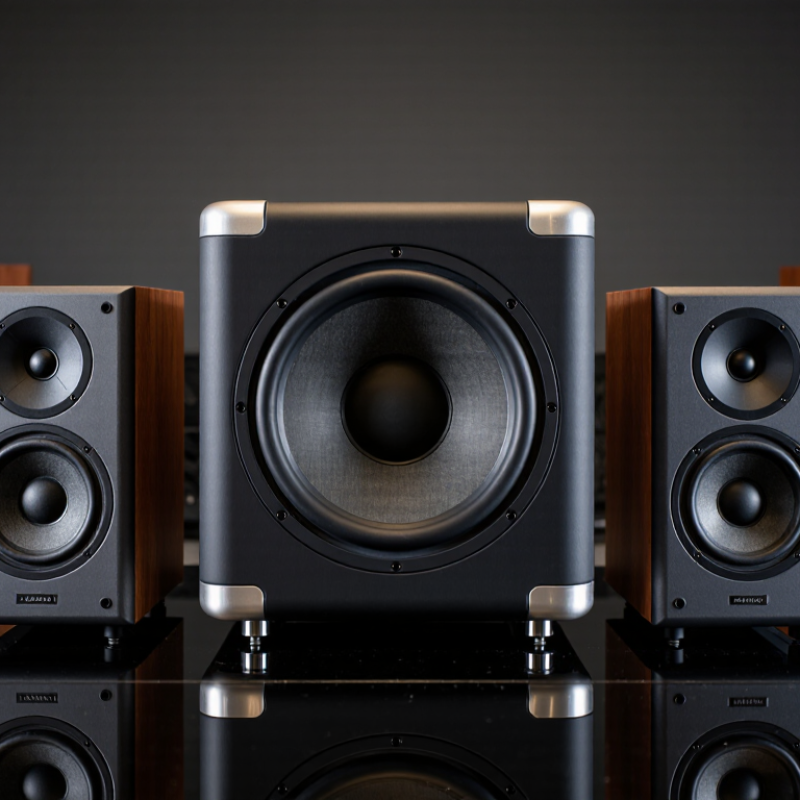
A sub speaker, often called a subwoofer, reproduces low-frequency sound that smaller speakers may struggle to deliver. It adds weight to a kick drum, the rumble of a film effect, or the deep note of a bass guitar. It does not simply make every system louder. Its job is to extend the system’s bass range and work with the main speakers, not compete with them. Placement matters. A sub tucked into a corner can sound louder, but sometimes uneven: one seat gets a heavy thump while another loses the bass almost entirely.
Room size, crossover settings, and cabinet design all affect performance. In a typical setup, the crossover tells the sub which low frequencies to handle; poor integration can leave a noticeable gap or a muddy overlap. Measurements help, but listening from several seats still matters. The room still wins. Grand View Research’s Loudspeaker Market Size, Share & Trends Analysis estimated the global loudspeaker market at USD 7.1 billion in 2023 and forecast growth through 2030. That figure covers loudspeakers broadly, not sub speakers alone, so it is useful market context rather than a subwoofer sales estimate. For global buyers, compare frequency response, amplifier power, connectivity, and published test conditions—not just peak wattage. One detail is easy to miss: specifications do not tell you how a unit will behave in your room.
Best Sub Speakers in China for Global Buyers - Understanding Sub Speakers and Their Role in Audio Systems
| Subwoofer Type | Typical Driver Size | Typical Frequency Range | Role in an Audio System | Common Applications | Key Points for Global Buyers |
|---|---|---|---|---|---|
| Compact sealed subwoofer | 8–10 inches | Approximately 35–200 Hz, depending on design | Adds low-frequency output with a compact enclosure; sealed designs are often chosen for controlled bass response. | Small home-theater rooms, desktop audio, and compact installations | Check cabinet dimensions, amplifier requirements, connection options, and the stated response tolerance. |
| Ported home subwoofer | 10–15 inches | Approximately 20–200 Hz, depending on tuning and design | Uses a port to increase output around the enclosure’s tuning frequency, which can support stronger bass at higher playback levels. | Home theater, living rooms, and larger listening spaces | Allow room for the cabinet and port airflow; compare maximum output and distortion data where available. |
| Powered subwoofer | Commonly 8–15 inches | Varies by model; often designed to cover part of the sub-bass and bass region | Includes a built-in amplifier, making it easier to pair with systems that provide a suitable subwoofer or line-level output. | Home audio, home theater, and some multimedia systems | Confirm input types, mains voltage and frequency, plug configuration, and any required regional safety documentation. |
| Passive subwoofer | Commonly 12–18 inches | Varies by driver, enclosure, and system configuration | Receives power from an external amplifier; useful when the installation requires a separately selected amplifier or system processing. | Installed sound, live audio, and custom audio systems | Match impedance and power handling to the amplifier, and confirm whether crossover or signal processing is required. |
| Professional PA subwoofer | Commonly 15–21 inches | Often designed for roughly 30–150 Hz, depending on the system | Provides low-frequency reinforcement beneath full-range PA speakers; multiple units may be used for larger venues. | Live events, venues, clubs, and touring sound systems | Review continuous power ratings, sensitivity, maximum SPL test conditions, connectors, cabinet weight, and transport dimensions. |
| In-wall or custom-install subwoofer | Varies by installation and enclosure | Model- and installation-dependent | Supplies low-frequency support while keeping equipment visually discreet or integrated into a fixed installation. | Residential installations, commercial spaces, and media rooms | Check required enclosure volume, mounting depth, ventilation, access for servicing, and compatibility with the installation structure. |
Related Posts
-

Ultimate Guide to Selecting the Perfect Subwoofer Speakers for Your Acoustic Needs
-

Why You Need Subwoofer Speakers for an Enhanced Audio Experience
-
2025 How to Choose High Fidelity Speakers for the Best Sound Experience
-

Top 10 Car Component Speakers for Superior Sound Quality?
-

How to Choose the Best High Fidelity Speakers for Your Home Audio System?
-

2026 Best Car Entertainment System Features and Reviews?