
How to Choose High Mast Street Lights in 2026?
Choosing a High Mast Street Light in 2026 requires more than comparing wattage or advertised brightness. A tall pole may illuminate a wide junction, port, airport road, or logistics yard, but poor optics can still create dark patches. The International Energy Agency’s Energy Efficiency 2023 report identifies efficient lighting and smart controls as practical opportunities for reducing electricity demand. That finding matters on large sites, where hundreds of fixtures may operate nightly. A small efficiency loss becomes a large operating cost.
Technical selection should begin with the lighting task. Review mounting height, road width, pole spacing, traffic speed, weather exposure, and maintenance access. CIE 115:2010 and EN 13201 provide useful frameworks for road-lighting performance, including illuminance, luminance, uniformity, and glare. The U.S. Department of Energy’s Solid-State Lighting research reports also emphasize LED efficacy, thermal management, controls, and long service life. These factors deserve attention. A 400-watt fixture is not automatically better than a 250-watt model. Its beam pattern, driver quality, and installation angle may matter more. Ask for photometric files, LM-79 test data, LM-80 or TM-21 evidence, surge protection ratings, and a realistic L70 lifetime. Marketing claims can sound precise, yet field conditions often disagree. Dust, salt air, heat, vibration, and cleaning delays quietly change performance. The right decision balances measured light quality, energy use, safety, maintenance, and total cost of ownership. In 2026, connected controls may improve scheduling and fault detection, but only when the site team can actually manage them. Fancy systems sometimes become expensive ornaments.
What Are High Mast Street Lights and Where Are They Used?
How to Choose High Mast Street Lights in 2026?
What Are High Mast Street Lights and Where Are They Used?
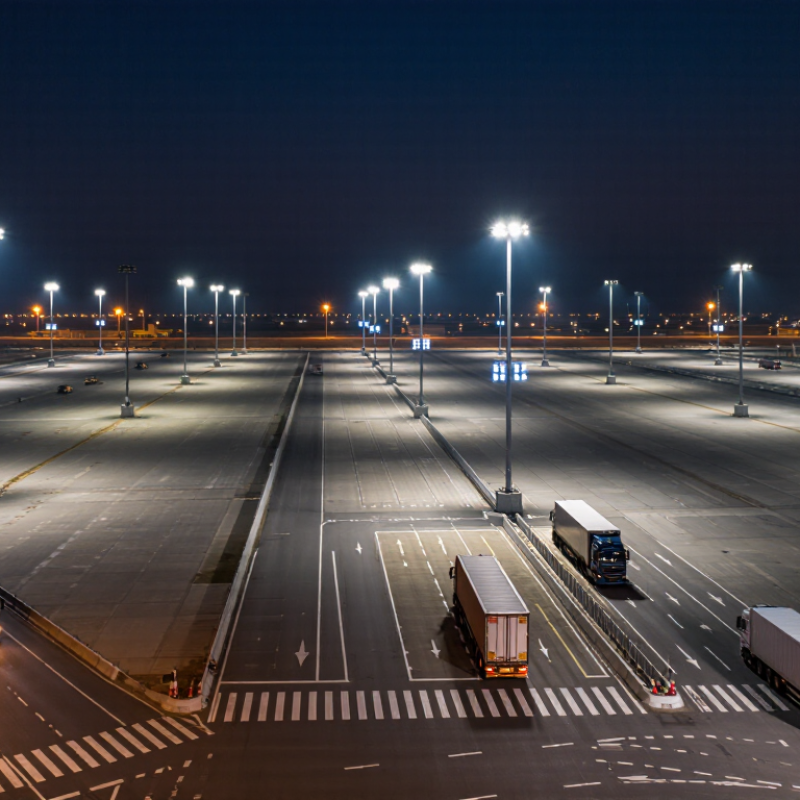
High mast street lights are tall outdoor lighting systems designed to illuminate wide areas. Their poles commonly reach 20 to 40 meters. A raised luminaire spreads light across roads, yards, and open facilities. This reduces pole clutter and limits obstacles near traffic lanes. The U.S. Federal Highway Administration’s Roadway Lighting Handbook identifies high mast lighting as suitable for interchanges and large transportation areas. These systems also serve ports, airports, stadiums, industrial parks, and logistics yards.
In 2026, selection should begin with site geometry, not wattage. The International Energy Agency estimates that lighting uses about 15% of global electricity consumption. That figure supports efficient upgrades, but not blind replacement. The U.S. Department of Energy’s 2023 Solid-State Lighting R&D Opportunities report describes laboratory LED packages exceeding 200 lumens per watt. Installed performance is usually lower. Specify roadway photometry, uniformity, glare control, and maintenance access. CIE 115 also provides useful guidance for road lighting classes.
Field experience reveals a common mistake: choosing fixtures before mapping shadows and mounting heights. High mast systems need precise asymmetric optics. At a container yard, narrow beams can leave dark areas between stacked units. At a highway interchange, excessive output may create glare for drivers. Controls can dim lighting during low-traffic periods, but sensors need careful commissioning. Include lowering equipment, wind-load checks, surge protection, and cleaning access in the design. That detail is easy to miss.
| Selection Dimension | Typical Data or Requirement | Practical Guidance for 2026 Projects |
|---|---|---|
| Definition | A high mast street light is a lighting system installed on a tall pole, commonly about 15–50 m high, with multiple luminaires mounted near the top. | The elevated mounting position distributes light over a large area and can reduce the number of poles required compared with conventional low-height street lighting. |
| Common Applications | Expressways, interchanges, large road junctions, ports, airports, logistics yards, rail terminals, industrial areas, and sports grounds. | High mast systems are most suitable for wide, open spaces where broad-area illumination is more important than closely spaced pedestrian-scale lighting. |
| Recommended Mounting Height | Approximately 15–25 m for many road and interchange projects; 25–50 m for very large areas, ports, and transport facilities. | The final height should be determined by the required coverage, pole loading, glare control, wind conditions, maintenance method, and local design standards. |
| LED System Power | Typically about 200–1,200 W per high-mast pole, depending on mounting height, road width, target illuminance, and the number of luminaires. | Do not select wattage alone. Confirm the photometric design, total connected load, dimming strategy, and energy-use calculations for the complete installation. |
| Typical LED Efficacy | Approximately 120–180 lm/W for current high-efficiency outdoor LED systems. | Compare tested luminaire efficacy rather than LED-chip efficacy. Optical losses, driver performance, operating temperature, and protective covers affect actual output. |
| Color Temperature | About 3,000–4,000 K is commonly used for roads and public areas; higher values may be selected where greater visual contrast is required. | Lower color temperatures can help limit blue-light content and improve visual comfort. The choice should consider road safety, surrounding communities, ecology, and local regulations. |
| Color Rendering | A CRI of 70 or higher is common for roadway lighting; CRI 80 or higher may be preferred in pedestrian, transport, or security-sensitive areas. | Higher CRI can improve the recognition of objects, signs, and vehicle colors, although it may influence efficacy and system cost. |
| Ingress Protection | IP65 or higher recommended | The first digit protects against dust; the second digit protects against water. Outdoor luminaires should be selected according to rain, cleaning practices, coastal exposure, and site conditions. |
| Impact Protection | IK08–IK10 is commonly considered for exposed outdoor installations. | A higher IK rating provides better resistance to mechanical impact. The required level depends on public access, nearby equipment, vandalism risk, and maintenance activity. |
| Pole Material | Galvanized structural steel is widely used; aluminum may be selected where lower weight or corrosion considerations are important. | Check material grade, hot-dip galvanizing or protective coating, weld quality, access openings, foundation design, and compatibility with the local environment. |
| Wind Design | The pole and luminaire assembly must be designed for the site-specific basic wind speed, exposure category, projected area, and safety factors. | Wind loading is a structural calculation, not a universal product value. Include the pole, headframe, luminaires, cables, and any accessories in the assessment. |
| Headframe Configuration | Fixed headframes may hold several luminaires; lowering headframes allow the luminaire assembly to be lowered for maintenance. | Lowering systems can reduce the need for high-reach equipment and may improve maintenance safety, but they require reliable winches, cables, locks, and inspection procedures. |
| Lighting Distribution | Wide, asymmetric, or area-distribution optics are commonly used for road corridors, junctions, yards, and open compounds. | Select optics using a photometric simulation. The design should control dark areas, excessive overlap, spill light, disability glare, and light trespass. |
| Illuminance Planning | The required average illuminance and uniformity vary by road class, traffic volume, pedestrian activity, conflict areas, and applicable standards. | Use the applicable national or municipal lighting standard. A suitable design should specify maintained illuminance, uniformity, glare limits, and maintenance assumptions. |
| Surge Protection | Outdoor LED systems commonly use surge protection in the range of 10–20 kV, selected according to the electrical environment and risk assessment. | Confirm whether protection is common-mode, differential-mode, or both, and verify coordination with upstream protective devices and the site earthing system. |
| Operating Temperature | Many outdoor LED luminaires are designed for approximately −40°C to +50°C ambient operation, subject to the product specification. | Check the actual local minimum and maximum temperatures, thermal management, driver location, solar heating, and expected lumen maintenance. |
| Control and Dimming | Astronomical clocks, photocells, 0–10 V, DALI, or networked controls may be used for scheduled dimming and monitoring. | Dimming during low-traffic periods can reduce energy consumption, but control compatibility, fail-safe operation, cybersecurity, and maintenance responsibilities should be defined. |
| Energy Performance | LED conversion can substantially reduce energy use compared with older discharge-lighting systems, especially when combined with adaptive dimming. | Evaluate annual kilowatt-hours, operating hours, dimming profiles, replacement costs, maintenance access, and expected service life rather than initial wattage only. |
| Service Life | A design target of 50,000–100,000 operating hours is common for LED luminaires, depending on temperature, drive current, and lumen-maintenance criteria. | Review the declared lumen-maintenance rating, driver life, failure-rate information, warranty terms, and replaceable-component availability. |
| Maintenance Access | Fixed systems may require a bucket truck or other lifting equipment; lowering systems can provide ground-level access to the luminaire assembly. | Include maintenance frequency, road-closure requirements, equipment rental, worker safety, spare parts, and emergency replacement procedures in the total-cost assessment. |
| Best Choice for 2026 | A properly engineered LED system with efficient optics, site-specific structural design, surge protection, adaptive controls, and maintainable components. | The best solution is not necessarily the highest-output model. Select the system that meets lighting standards while balancing safety, energy use, glare control, lifecycle cost, and maintenance access. |