How to Choose the Best Car Audio Amplifiers for Your Needs?
When it comes to enhancing your vehicle's sound system, choosing the right car audio amplifiers is crucial. With a multitude of options available, selecting the best amplifier can be overwhelming. Understanding your unique needs is vital in making an informed decision.
Car audio amplifiers boost the power of your speakers. They improve sound clarity and volume, creating a lively audio experience in your car. However, not every amplifier is suitable for every system. Factors such as power output, size, and compatibility with your existing components must be considered.
Many people overlook the importance of research. Reading reviews and consulting experts can provide valuable insights. It's easy to get lost in flashy advertisements, but focusing on quality ensures lasting satisfaction. Car audio amplifiers should not only fit your budget but also elevate your listening experience. Reflect on your preferences, and take the time to choose wisely.
Understanding Car Audio Amplifiers: Types and Functions
Car audio amplifiers play a crucial role in any sound system. They boost audio signals, enhancing clarity and volume. Understanding the different types can dramatically impact your listening experience. Class A and Class D amplifiers are popular choices. Class A amplifiers produce high-quality sound, but they can be inefficient. Class D amplifiers, on the other hand, are power-efficient, making them ideal for modern vehicles.
Industry reports indicate that audio quality significantly affects customer satisfaction. According to a study by the Consumer Electronics Association, nearly 70% of car enthusiasts value great sound. They look for features such as signal-to-noise ratio (SNR) and total harmonic distortion (THD) ratings. A good SNR ensures clear audio, while low THD keeps sound distortion at bay.
Choosing the right amplifier requires careful consideration of your needs. For example, if you prioritize sound quality over power, a Class A may be your best bet. But if you need a powerful, efficient solution for bass-heavy music, consider Class D. Balancing these factors can help avoid potential regrets.
Key Specifications: Power Ratings, Impedance, and Efficiency
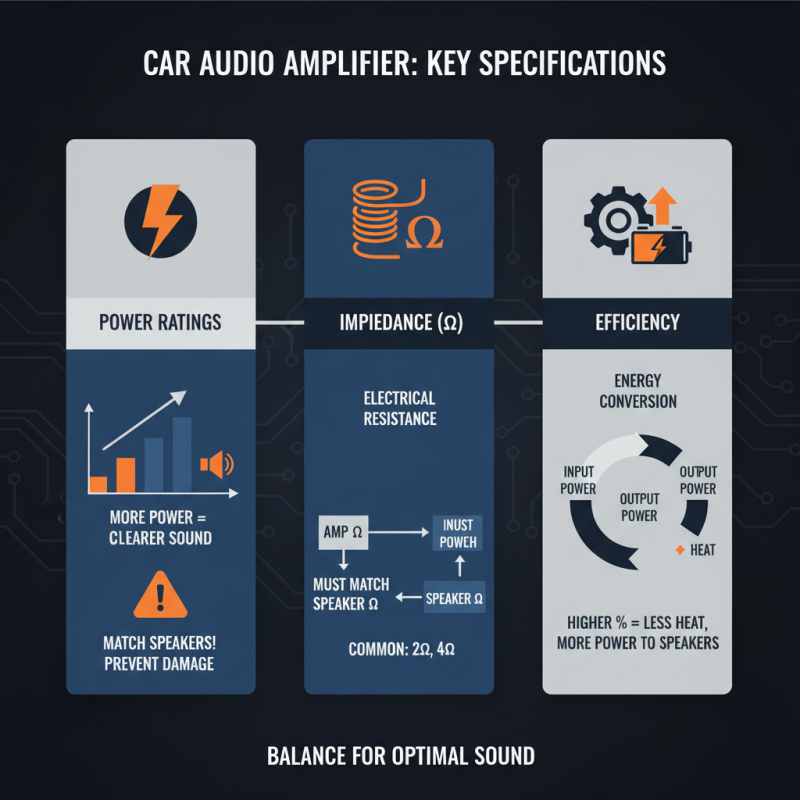
Choosing the right car audio amplifier requires careful consideration of key specifications. Power ratings play a critical role in this decision. Power indicates how much energy the amplifier can deliver to your speakers. More power means louder sound without distortion. However, it's important to match the power output to the speaker capabilities. An overpowered speaker can be damaged easily. This balance is crucial for a satisfying audio experience.
Impedance is another essential factor. It defines the resistance the amplifier faces. Most car audio systems operate at 2, 4, or 8 ohms. Lower impedance allows for more power to flow, yet it can stress the amp. You should ensure that the impedance of the amplifier aligns with your speaker's rating to avoid overheating. If the amp cannot handle the load, performance will suffer.
Efficiency is a key metric for assessing amplifiers. Class-D amplifiers are often more efficient, producing less heat. This translates into more power for your speakers and greater energy savings. However, efficiency may sometimes compromise sound quality. It's essential to find an amplifier that balances both elements. Testing various setups can reveal what works best for your car audio needs. Making an informed decision enhances your listening pleasure.
Evaluating Sound Quality: THD, SNR, and Frequency Response
Evaluating sound quality in car audio amplifiers hinges on three key metrics: Total Harmonic Distortion (THD), Signal-to-Noise Ratio (SNR), and Frequency Response. THD measures how much a signal is distorted during amplification. Ideally, a lower THD results in clearer sound. For instance, a THD value below 0.1% is generally considered excellent. This means that 99.9% of the signal, or nearly all of it, stays pure. High-end studies indicate that even a slight increase in THD can noticeably affect listening quality.
Next is the Signal-to-Noise Ratio (SNR). SNR indicates the level of the desired signal relative to background noise. A higher SNR generally leads to better quality sound. Many experts recommend seeking amplifiers with at least a 90 dB SNR for optimal performance. At lower SNR levels, listeners may hear unwanted static and distortion. Some amplifiers, despite good THD metrics, can fall short in SNR, highlighting the importance of a balanced approach.
Finally, Frequency Response indicates the range of frequencies an amplifier can handle. A wider frequency response results in richer sound. A typical car audio amplifier should ideally cover 20 Hz to 20 kHz. However, it’s essential to note that not all amplifiers adhere to this standard. Some may excel in one metric while lacking in others, reminding us to carefully evaluate all aspects. Striking a balance among THD, SNR, and Frequency Response is crucial for achieving the best audio experience in your vehicle.
How to Choose the Best Car Audio Amplifiers for Your Needs? - Evaluating Sound Quality: THD, SNR, and Frequency Response
| Amplifier Model |
Total Harmonic Distortion (THD) |
Signal-to-Noise Ratio (SNR) |
Frequency Response |
| Model A |
0.05% |
105 dB |
20 Hz - 20 kHz |
| Model B |
0.08% |
98 dB |
15 Hz - 22 kHz |
| Model C |
0.02% |
110 dB |
10 Hz - 20 kHz |
| Model D |
0.1% |
100 dB |
20 Hz - 18 kHz |
| Model E |
0.03% |
107 dB |
20 Hz - 25 kHz |
Matching Amplifiers with Speakers: Power Handling and Compatibility
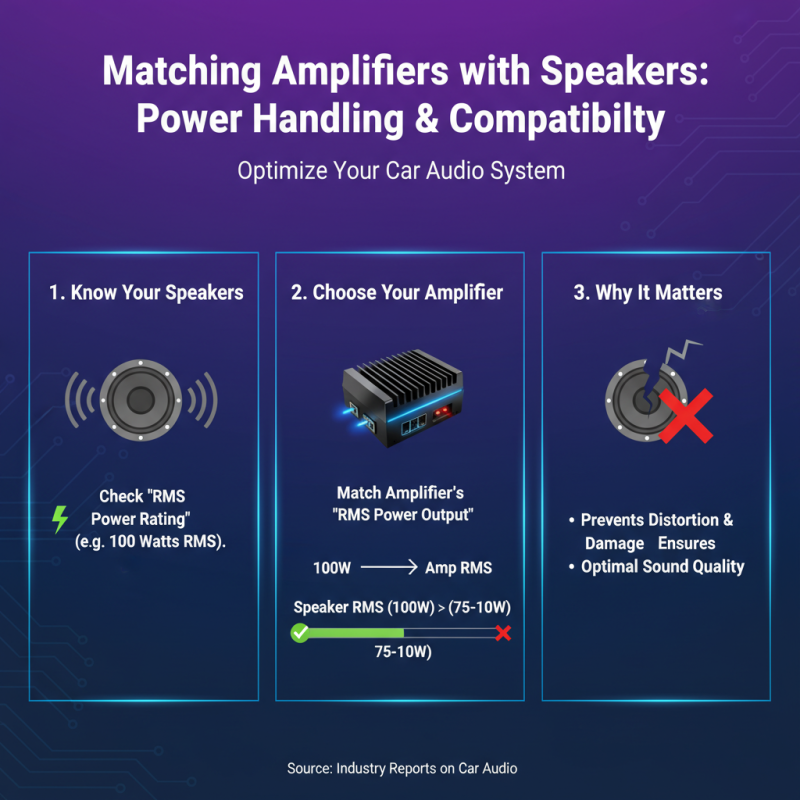
When choosing a car audio amplifier, compatibility with your speakers is crucial. Power handling is a key aspect to consider. An amplifier must match the speaker's power rating. For example, if your speakers are rated at 100 watts RMS, an amplifier producing between 75 to 100 watts RMS is ideal. According to industry reports, mismatched power ratings can lead to distortion or damage, affecting overall sound quality.
Understanding the impedance is also vital. Most car audio systems use 4-ohm speakers, but some may operate at 2 or 8 ohms. Select an amplifier that can efficiently drive the speaker impedance you have. For instance, a 2-ohm amplifier will produce more power but generate more heat, requiring adequate ventilation.
Tip: Always check your speaker’s specifications before making any purchases. It helps avoid potential disappointment.
Another consideration is the amplifier's total harmonic distortion (THD). A lower THD percentage means cleaner sound output. Aim for amplifiers with THD below 1%. While a high-quality amp might be pricier, it leads to long-term benefits in sound clarity.
Tip: Be willing to invest in quality components. Skimping on the amp can degrade your audio experience. Always assess if an investment will yield satisfying results.
Installation Considerations: Wiring, Placement, and Calibration Tips
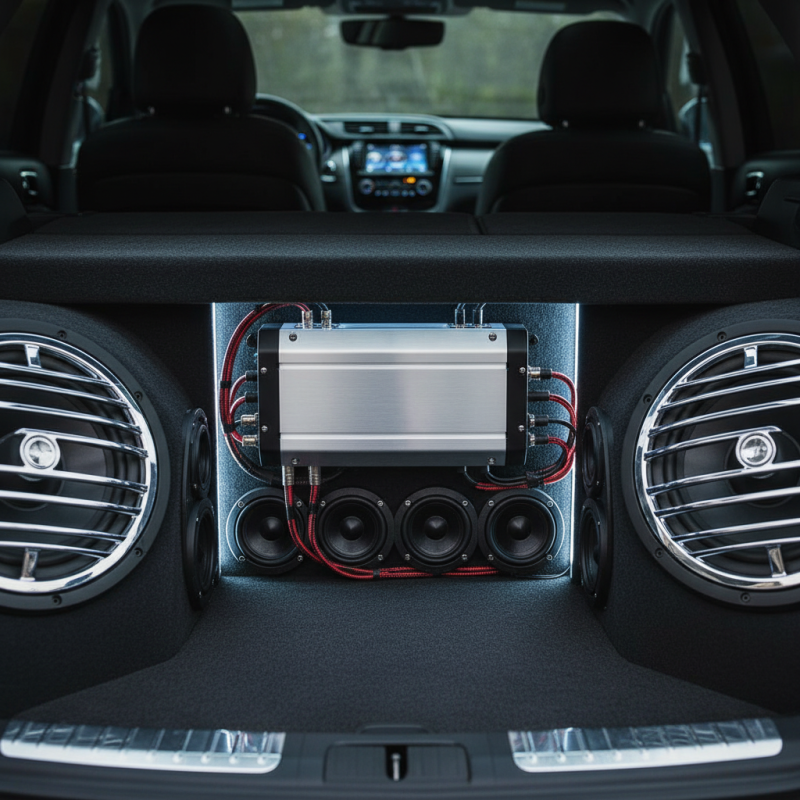
When considering car audio amplifiers, installation is key. Proper wiring ensures clear sound quality and prevents electrical issues. Use high-quality cables to reduce interference. Match your amplifier’s power requirements with the speaker’s capacity. Overloading can damage your system. Regularly check connections for wear.
Placement of the amplifier affects performance. An ideal location is away from heat sources. Ventilation is crucial for optimal operation. You might need to reposition your amp for better sound distribution. Test different placements to find the best acoustic balance.
Calibration enhances audio output. Use a sound level meter to adjust settings accurately. Many underestimate the importance of fine-tuning. Listen for distortion and adjust accordingly. It may take time, but the results are worth the effort. Remember, every car and system is different. Embrace trial and error for the best outcome.
Analysis of Car Audio Amplifier Features