How to Choose the Right Audio System?
Choosing the right audio system is less about buying the biggest speakers and more about matching sound to your room, habits, and budget. A compact stereo can suit a small apartment; a surround setup may make sense for a dedicated movie room. Room size, listening distance, speaker placement, and source quality all affect what you hear. Small details matter. A sofa against the wall can change bass response, while a speaker tucked into a corner may sound noticeably heavier.
The market is growing, but more choice does not guarantee a better fit. Grand View Research’s Home Audio Equipment Market report estimated the global market at USD 27.8 billion in 2023 and projected continued growth through 2030. That scale reflects broad demand, not a reason to overspend. Dr. Floyd Toole, an acoustician and author of Sound Reproduction, emphasizes the connection between loudspeakers and listening rooms: “The room is part of the loudspeaker.” Treat that as practical guidance, not a shopping slogan. Compare systems using familiar recordings, check connection needs, and consider whether you can position the speakers properly. A showroom can help, but it cannot reproduce your home. That part is easy to underestimate. Even a careful shortlist may need revision after you hear the system in your own space. This guide explains how to weigh sound quality, room fit, features, and long-term value before choosing an audio system.
Define Your Listening Needs and the Space
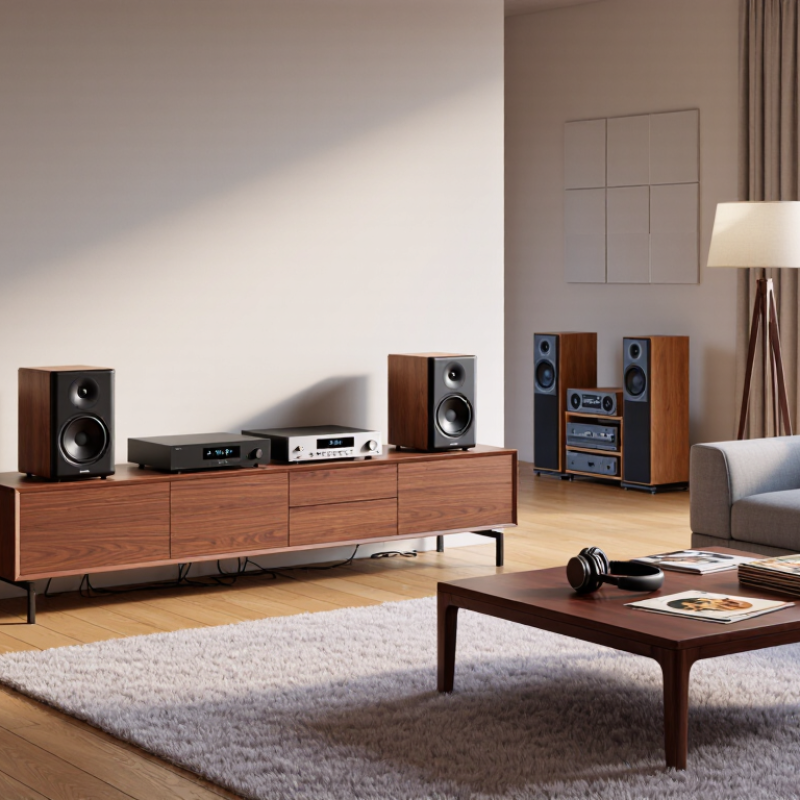
Start with what you listen to most. Music, films, games, and spoken audio place different demands on a system. Clear dialogue may matter more than deep bass in a small apartment. For music, note whether you listen quietly or fill the room. Also consider how many people need to hear evenly. A setup for one chair can sound very different across a crowded sofa.
Then measure the space, including room length, width, ceiling height, and speaker-to-seat distance. Hard floors and bare walls can make reflections harsh; thick curtains and rugs may soften them. The European Broadcasting Union’s EBU Tech 3276 recommends a reverberation time of roughly 0.2–0.4 seconds for reference listening rooms. This is a useful benchmark, not a rule for every home. Small rooms behave differently. Even careful plans can miss a bass peak, so listen in the actual space before settling on placement.
Tips: Sketch the room and mark doors, windows, and seats. Measure your main listening distance. Try speakers where they can sit comfortably, then adjust after listening. Leave room to revise; the first layout is not always the best.
How to Choose the Right Audio System: Define Your Listening Needs and Space
Room volume is calculated as length × width × ceiling height. These examples show how much the listening space can vary; larger rooms and longer listening distances generally require more acoustic output. Consider your room layout, listening habits, and desired volume when comparing audio systems.
Identify the Audio System Components and Configurations
Choosing an audio system begins with identifying its signal path: source, processor or receiver, amplifier, speakers, and any subwoofer. A compact powered speaker combines several parts, while a separates-based system gives more upgrade options but needs more space and careful matching. Check each device’s inputs before buying; a television, turntable, and streaming player may require different connections. Small detail, big headache.
Configuration should follow the room and listening habits. Stereo uses two main speakers and suits music in a small room. A 2.1 setup adds a subwoofer for deeper bass. For surround sound, ITU-R Recommendation BS.775-3 describes a 5.1 layout with three front channels, two surround channels, and a low-frequency effects channel. That channel count is a useful planning reference, not a promise of better sound. Speaker placement and room reflections still matter.
For clear dialogue and balanced playback, consider calibration and listening distance, not just amplifier wattage. The European Broadcasting Union’s R 128 recommendation sets programme loudness at -23 LUFS for broadcast audio; this is a broadcast reference, not a home-system volume target. Listen at your usual seat, then adjust levels with familiar speech and music. I’ve found that a modest system placed well can outperform a larger setup squeezed into corners. Even so, room acoustics are easy to underestimate.
Compare Sound Quality and Technical Specifications
Compare audio systems using frequency response, distortion, sensitivity, impedance, and maximum sound-pressure level. Numbers need context. A wide frequency-response range looks impressive, but it says little about tonal balance or performance at your usual listening volume. Check whether distortion figures use the same measurement conditions; otherwise, comparisons can mislead. Sensitivity helps estimate how loudly a speaker plays from a given amplifier output, while impedance affects amplifier demands. Small details matter.
Use the same recording and match playback levels before judging clarity, bass, or vocal detail. The European Broadcasting Union’s R 128 recommendation sets programme loudness at −23 LUFS; this is a broadcast reference, not a rating for speakers or amplifiers. It illustrates why source level should be controlled during comparisons. The ITU-R BS.1116 recommendation specifies a listening-room reverberation time of 0.2–0.4 seconds across 200 Hz to 4 kHz for certain subjective audio tests. Your living room may differ. Reflections from a bare wall can change perceived brightness, while a rug may soften them. A spec sheet cannot capture that. I would treat published figures as useful filters, then listen at realistic volumes in the space where the system will actually be used.
Check Device Compatibility, Connectivity, and Installation Requirements
Start with the devices you plan to connect, not the system’s feature list.
Check which audio outputs your television, computer, or turntable provides. HDMI ARC or eARC, optical, and analog connections are not interchangeable. With passive speakers, confirm that the amplifier supports their impedance and suits their power requirements. Wireless systems need a stable connection and compatible streaming features. Check the manual. A connector that fits may not carry the sound format you expect, so verify supported formats before buying.
Installation requirements can change what works in practice.
Measure the shelf, cabinet, or wall space, including room for cables and airflow. Measure twice. Check for nearby power outlets and plan cable routes that avoid doorways and tight bends. Wall-mounted speakers need secure fixings and a suitable surface; placement near corners can also affect bass. Before installation, test the system in the intended room and at a comfortable volume. A spec sheet cannot predict every room’s reflections, and even careful measurements may miss an awkward cable path. Be ready to adjust the layout.
Balance Your Budget With Reliability and Future Support
A low purchase price can be misleading if cables, stands, or room correction add unexpected costs. Set a complete budget before comparing systems. Include installation, replacement parts, and any subscription needed for essential features. Leave a small reserve for a missing adapter or a longer cable. Small items add up.
Reliability is easier to judge through details than polished product claims. Check the warranty length, service process, and availability of replacement components. Look for clear setup instructions and support that can help diagnose dropouts or distorted sound. Ask how repairs are handled after the warranty ends. That matters. If possible, listen at a realistic volume in a room similar to yours. A system that sounds impressive for five minutes may become tiring during a long evening.
Future support deserves space in the budget, too. Confirm that the system accepts common connections you already use, and consider whether its software receives updates. Compatibility can change. A receiver with useful inputs may outlast a feature-heavy model that depends on one app. Still, no checklist predicts every failure, and published specifications cannot reveal how a system will feel in your home. Compare the ongoing costs against your actual listening habits, not an imagined perfect setup.