Choosing the best subwoofer for car audio is not simply a matter of buying the largest speaker. A powerful model can sound weak when the enclosure, amplifier, or vehicle space is poorly matched. The right setup should produce tight, controlled bass without drowning out vocals or rattling the doors.
This guide explains the practical details that matter before you spend money. You will learn how to compare powered and passive subwoofers, understand RMS power, choose a suitable enclosure, and measure available space. A compact under-seat model may suit a small hatchback, while a sealed trunk enclosure may deliver deeper and cleaner bass in a sedan. Check the manufacturer’s RMS ratings, not only peak wattage. Peak numbers often look impressive but provide limited guidance during daily listening.
Listen carefully.
In my experience, installation quality can matter as much as the subwoofer itself. Secure wiring, correct amplifier gain, and proper polarity help prevent distortion and uneven bass. However, no recommendation fits every driver. Music preferences, listening volume, budget, and vehicle insulation all change the result. I have also found that stronger bass is not always better; excessive output can become tiring on long journeys. This guide will help you make a balanced decision based on measurable specifications and realistic cabin conditions. It will also point out common mistakes, because even careful buyers can overlook heat, cargo access, or future upgrade plans.
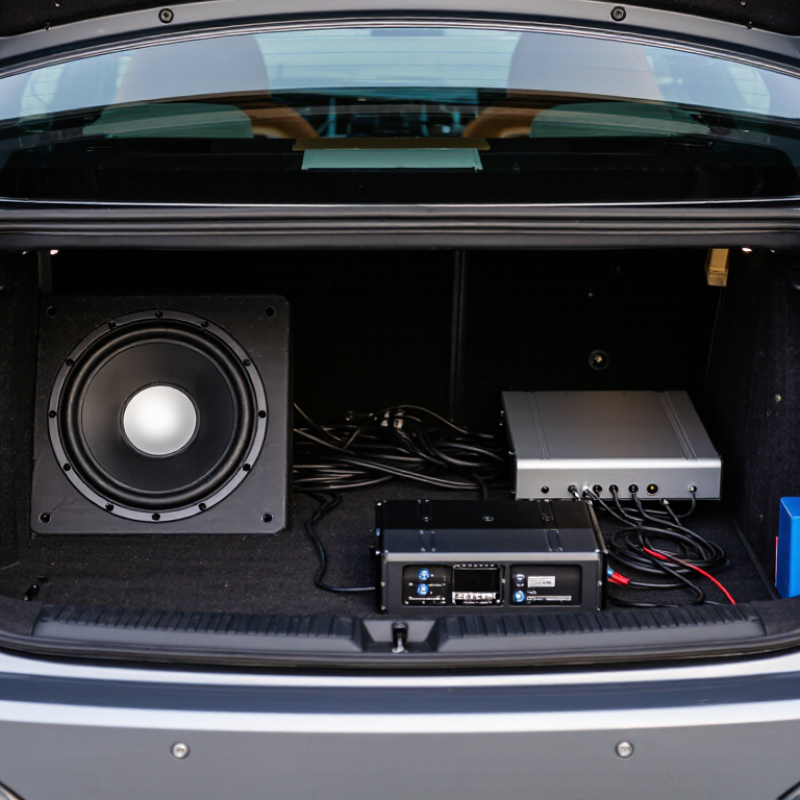
Choosing the best subwoofer for your car starts with a clear bass goal. Do you want tight, musical impact or deep, physical rumble? These goals require different designs and settings. A subwoofer’s useful range may cover 20–200 Hz, but your car’s cabin changes what you actually hear.
Begin by identifying the target frequencies.
Frequencies below 40 Hz create deep rumble, while 40–80 Hz often delivers kick-drum weight and bass guitar presence. The 80–200 Hz region adds warmth, but too much can make the system sound muddy.
Keep the transition smooth with a carefully adjusted low-pass crossover. I usually begin near 80 Hz, then listen from the driver’s seat. Small changes matter.
Your enclosure also affects the result.
A sealed enclosure often produces controlled, accurate bass. A ported enclosure can deliver more output around its tuned range, but poor tuning may sound swollen.
I once judged a system from outside the car and chose too much output. Inside the cabin, it became tiring after ten minutes. That mistake changed my approach.
Measure available space, check amplifier power, and consider listening comfort. Bigger is not automatically better. Leave room for adjustment, because real-world acoustics rarely match specifications perfectly.
How to Choose the Best Subwoofer for Your Car?
Match RMS power ratings under the CTA-2031 subwoofer standard, not casual peak-power claims. CTA-2031 provides a more consistent method for evaluating continuous power handling. This makes comparisons more meaningful across different subwoofers. A 500-watt CTA-2031 rating suggests the subwoofer can handle sustained power under defined testing conditions. It does not guarantee identical performance inside every vehicle.
Check the amplifier’s RMS output at the subwoofer’s actual impedance. A practical target is an amplifier producing about 75% to 100% of the subwoofer’s CTA-2031 rating. This leaves some operating margin and reduces thermal stress. For example, a 400-watt subwoofer may pair well with an amplifier delivering 300 to 400 watts RMS. Confirm the wiring load carefully. A mismatched impedance can change the amplifier’s real output significantly.
Listen for control, not only volume. A properly matched system should produce tight bass without burning smells, harsh distortion, or repeated protection shutdowns. Use a sealed enclosure when accuracy matters, or a correctly tuned ported enclosure for more output. The enclosure changes how the subwoofer uses power. I have found that installation quality often matters more than a larger rating. That is easy to overlook. CTA-2031 improves the comparison, but room gain, cabin size, and tuning still affect results. I would also recheck every specification before buying, because published ratings can contain unclear test conditions.
How to Choose the Best Subwoofer for Your Car?
Impedance determines how much electrical load the subwoofer places on an amplifier. Check the amplifier’s stable ohm rating before choosing a subwoofer. A 2-ohm subwoofer can demand more current than a 4-ohm model. That may produce greater output, but it also creates more heat. Never connect a load below the amplifier’s recommended limit. Wiring changes the final impedance, especially with dual voice coils. Series wiring raises resistance, while parallel wiring lowers it. Measure carefully, because small wiring mistakes can damage equipment.
Sensitivity shows how efficiently a subwoofer converts power into sound. It is usually listed in decibels at a specific test condition. A higher rating can deliver more volume from the same amplifier power. However, sensitivity figures are not always measured identically. Treat them as useful guidance, not perfect laboratory truth. The subwoofer’s RMS power handling should also match the amplifier’s continuous RMS output. Peak power ratings often look impressive but help less during daily listening.
In my installations, I check impedance, RMS power, and sensitivity together. I also inspect the enclosure size and available electrical capacity. A technically suitable subwoofer may sound weak in a poorly sealed box. Set the gain with a test track and listen for harsh distortion. I once focused too heavily on wattage and overlooked sensitivity. The system played loudly, but the amplifier worked harder than expected. That mistake changed my selection process. Reliable results come from matching the entire system, not chasing one specification.
| Subwoofer Configuration | Nominal Impedance | Recommended Amplifier Output | Typical Sensitivity | Typical RMS Power | Best Amplifier Load Setting | Installation and Use Characteristics |
|---|---|---|---|---|---|---|
| 8-inch compact subwoofer, single voice coil | 4 ohms | 150–300 watts RMS at 4 ohms | 82–86 dB | 200–300 watts | Use a stable 4-ohm mono or two-channel amplifier | Requires less enclosure space and is suitable for compact cars or moderate low-frequency improvement. |
| 10-inch balanced subwoofer, single voice coil | 4 ohms | 250–500 watts RMS at 4 ohms | 84–88 dB | 300–500 watts | Match the amplifier's continuous output closely to the subwoofer's RMS rating | Provides a good balance between bass extension, enclosure size, and power demand. |
| 10-inch high-output subwoofer, dual voice coil | 2 ohms or 4 ohms, depending on wiring | 400–800 watts RMS at the final wired impedance | 83–87 dB | 500–800 watts | Confirm that the amplifier is stable at the selected final impedance | Offers flexible wiring options, but both voice coils should be wired correctly and receive equal power. |
| 12-inch standard subwoofer, single voice coil | 4 ohms | 300–600 watts RMS at 4 ohms | 85–89 dB | 400–600 watts | A 4-ohm mono amplifier is usually the simplest match | A practical choice for deeper bass in sealed or ported enclosures with moderate trunk-space requirements. |
| 12-inch high-power subwoofer, dual voice coil | 2 ohms or 4 ohms, depending on wiring | 600–1,200 watts RMS at the final wired impedance | 84–88 dB | 750–1,200 watts | Use an amplifier whose stable output matches the final series or parallel wiring load | Suitable for high-output systems; requires adequate electrical capacity, enclosure strength, and ventilation. |
| 15-inch low-frequency subwoofer, dual voice coil | 2 ohms or 4 ohms, depending on wiring | 800–1,500 watts RMS at the final wired impedance | 86–91 dB | 1,000–1,500 watts | Choose a high-current mono amplifier that remains stable at the selected load | Produces strong low-frequency output but normally needs a larger enclosure and more vehicle space. |
| Shallow-mount 10-inch subwoofer | 2 ohms or 4 ohms | 200–500 watts RMS at the final impedance | 80–85 dB | 250–500 watts | Prioritize amplifier impedance stability over maximum advertised power | Designed for limited installation depth; sensitivity may be lower, so adequate amplifier power is important. |
| Shallow-mount 12-inch subwoofer | 2 ohms or 4 ohms | 300–700 watts RMS at the final impedance | 81–86 dB | 400–700 watts | Use an amplifier that delivers its rated continuous power at the wired impedance | Provides more cone area than a shallow 10-inch design while fitting installations with restricted depth. |
Selection rule: match the amplifier's continuous RMS output and stable impedance rating to the subwoofer's final wired load. Sensitivity is measured in decibels and indicates how efficiently a subwoofer produces sound; a higher sensitivity rating generally requires less amplifier power for a similar volume level.
A sealed enclosure is compact, predictable, and often easier to tune. Its air volume acts like a spring behind the woofer. This usually produces tighter bass and smoother control. However, sealed systems lose output below their natural resonance. Their response typically falls at about 12 dB per octave. More amplifier power may be needed for deep bass.
A ported enclosure uses a tuned vent to reinforce low frequencies. Around the tuning point, output can increase noticeably with less amplifier demand. Many designs target 30–35 Hz for strong music-focused bass. Below that frequency, output drops rapidly, often near 24 dB per octave.
ANSI/CTA-2031-A measurement practices emphasize comparing frequency response, sensitivity, and distortion under consistent conditions. AES loudspeaker research also shows that enclosure volume and tuning strongly affect transient behavior. These measurements matter more than advertised peak wattage. I once preferred ported bass, but poorly tuned vents sounded loose and boomy.
Tips: Check the driver’s Thiele-Small parameters before choosing an enclosure. Match the recommended internal volume carefully. Leave space for bracing and the vent. For daily listening, sealed boxes suit controlled bass and limited cargo space. Choose ported designs when higher output matters most. Avoid tuning below the driver’s safe operating range. That mistake is easy to make.
How to Choose the Best Subwoofer for Your Car?
Verify the installation space before comparing cone sizes. Measure height, width, depth, and the enclosure’s required air volume. A tape measure beats guesswork. Leave clearance for wiring, ventilation, and seat movement. Grand View Research forecasts the global automotive audio market to grow at about 5.4% annually from 2024 to 2030. Fortune Business Insights reports a similar expansion trend, driven partly by demand for improved in-car sound. Market growth does not guarantee a suitable fit.
For cone size, a 10-inch unit often balances bass output and cargo space. A 12-inch cone can move more air, but it usually needs a larger enclosure and stronger electrical support. Cone diameter alone is not enough. Check the driver’s displacement and recommended sealed or ported volume. A cramped enclosure can make bass sound slow and uneven. Small details matter.
Match the subwoofer’s RMS power with the amplifier’s RMS output at the same impedance. Ignore exaggerated peak-power figures. Confirm battery capacity, fuse rating, cable gauge, and available mounting depth. In real installations, installers sometimes overlook the enclosure’s displacement. I have seen a “perfect” fit fail after the terminal wiring consumed valuable space. Recheck every measurement before cutting panels. Room for error is limited.