Download the 2025 Focal Car Catalogue | Focal INSIDE Catalogue | Join our Mailing List!

Why Do You Need a Subwoofer for Car Audio?

Why do you need a subwoofer for car audio? The answer begins with the frequencies your factory speakers cannot reproduce confidently. Door speakers often handle vocals, guitars, and cymbals well. Deep bass is different. It needs greater cone movement and careful enclosure control.

A subwoofer for car systems adds weight to kick drums, bass guitars, and cinematic sound effects. You may feel a clean pulse through the seat instead of hearing a thin rattle from the doors. That physical impact can make familiar songs feel more complete. It should not overpower the singer. Poor tuning can make the cabin sound muddy.

I learned this through practical listening tests. A compact, sealed subwoofer produced tighter bass in one small hatchback. A ported enclosure played louder, but it needed more space and careful placement. Neither design was automatically better. Vehicle size, amplifier power, music preferences, and available cargo room all matter.

This guide uses basic acoustic principles, manufacturer specifications, and realistic installation considerations. It explains enclosure types, amplifier matching, crossover settings, and safe wiring practices. Reliable results require more than buying the largest driver. Gain settings should be adjusted gradually. Electrical demand should match the vehicle and amplifier. Professional installation may be sensible when factory wiring is complex.

Some listeners may not need a subwoofer at all. That is worth admitting. If your current system already delivers balanced bass, an upgrade may offer limited value. Still, when low notes sound weak, a properly matched subwoofer can transform the listening experience without replacing every speaker.
Why Do You Need a Subwoofer for Car Audio?

What a Subwoofer Does in a Car Audio System

Why Do You Need a Subwoofer for Car Audio?

What a Subwoofer Does in a Car Audio System

A car subwoofer is designed to reproduce deep bass that regular door speakers often cannot handle well. Unlike smaller speakers, it moves more air at low frequencies. This creates stronger kick drums, fuller movie effects, and a more realistic sense of space. You can feel it in the seat.

In a typical system, the subwoofer receives low-frequency signals through a crossover. The crossover keeps deep bass away from speakers that may sound strained at high volume. This division allows the main speakers to focus on vocals, guitars, and other details. The result can sound cleaner, not merely louder. A suitable enclosure also controls the speaker’s movement and reduces unwanted vibration.

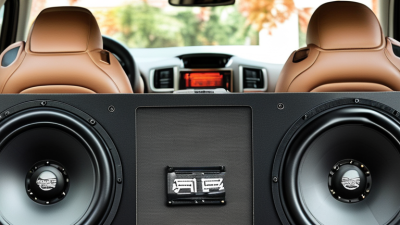
Placement matters inside a small cabin. A subwoofer near the rear area may produce powerful bass, but poor positioning can create uneven notes. Some frequencies may seem boomy, while others nearly disappear. I have noticed this during basic listening tests. Small adjustments can change the result. Phase settings and crossover levels deserve careful attention.

More bass is not always better. Excessive output can hide vocals and make the system tiring. A properly adjusted subwoofer should support the music, not dominate it. Still, personal preference affects every setup. Even experienced installers may need several adjustments. I once preferred heavier bass, then reduced it after hearing clearer vocals. The first setting sounded exciting, but not accurate.

Why Do You Need a Subwoofer for Car Audio?

Low-frequency wavelengths become much longer as pitch decreases, which is why dedicated subwoofers are used to reproduce deep bass effectively.

This chart uses the speed of sound in air at approximately 20°C (343 m/s). Wavelength is calculated as speed ÷ frequency. Frequencies from about 20–120 Hz contain the deepest bass and require substantial speaker movement, enclosure volume, and amplifier power. A subwoofer handles this range so the main speakers can focus on midrange detail and vocals.

How Low-Frequency Sound Improves Music Quality

Why Do You Need a Subwoofer for Car Audio?

How Low-Frequency Sound Improves Music Quality

A subwoofer handles the deep frequencies that small car speakers often struggle to reproduce. These sounds include kick drums, bass guitars, floor toms, and the low rumble in film audio. When bass is weak, music can sound thin and overly bright. A dedicated subwoofer adds weight without forcing the main speakers to work beyond their limits.

The difference is easy to notice during careful listening. A kick drum feels tighter, not merely louder. Electronic bass gains a smooth physical presence, while orchestral music reveals deeper room ambience. Most car audio systems benefit from frequencies below roughly 80 Hz, although the ideal crossover depends on the speakers and cabin. Proper adjustment matters. Excessive bass can mask vocals and create muddy resonance.

I once increased the level too quickly and mistook vibration for quality. It was not. After lowering the gain and adjusting the crossover, familiar recordings sounded more balanced. Placement also changed the result; one position produced a strong boom near the rear seats, while another sounded cleaner. A subwoofer needs suitable enclosure design, secure installation, and accurate tuning. The car interior can amplify low frequencies unpredictably, so listening from the driver’s seat remains important. Measurements help, but personal evaluation still has value. My first settings were not perfect, and they probably never will be.

Why Do You Need a Subwoofer for Car Audio? - How Low-Frequency Sound Improves Music Quality

Key low-frequency audio data and practical benefits of adding a dedicated subwoofer to a car sound system

Data Dimension Typical Value or Range What It Means in a Car Audio Benefit
Human hearing range Approximately 20 Hz–20 kHz for healthy young listeners The lowest part of the audible range requires substantial air movement to reproduce clearly. Preserves the full frequency range of recordings instead of reducing the lowest musical content.
Sub-bass region 20–60 Hz Contains deep kick-drum impact, synthesizer bass, pipe-organ fundamentals, and cinematic low-frequency effects. Adds depth and physical impact when reproduced without excessive distortion.
Upper-bass region 60–120 Hz Includes much of the punch of kick drums, bass guitars, toms, and electronic bass lines. Improves punch and helps the overall mix sound fuller when the crossover is correctly adjusted.
Common subwoofer crossover area About 60–100 Hz, system dependent The subwoofer handles the lowest frequencies while the main speakers handle more midrange and treble content. Reduces the low-frequency workload on small door or dashboard speakers.
Low-frequency wavelength at 20 Hz Approximately 17.2 m at 20°C Very low frequencies interact strongly with the vehicle cabin and its boundaries. Explains why subwoofer placement, phase, and equalization can significantly change bass response.
Low-frequency wavelength at 40 Hz Approximately 8.6 m at 20°C The wavelength is still much larger than the vehicle interior, so cabin gain and standing-wave effects are important. A properly integrated subwoofer can produce smoother and more consistent bass across the listening position.
Speaker excursion demand Increases as frequency decreases for the same sound-pressure target Small full-range speakers have limited cone travel and enclosure volume, restricting deep-bass output. A dedicated subwoofer provides a driver and enclosure designed for greater low-frequency displacement.
Distortion risk from overloaded main speakers Rises when a small driver is pushed beyond its linear excursion capability Trying to reproduce deep bass at high volume can cause compression, rattling, or audible distortion. High-pass filtering the main speakers can improve clarity and reduce mechanical strain.
Phase alignment 0° or 180° polarity options are common; continuously adjustable phase may also be available Incorrect alignment near the crossover frequency can cause cancellation and a weak bass response. Correct alignment produces a more seamless transition between the subwoofer and main speakers.
Recommended setup priority Crossover, gain, phase, and enclosure placement should be tuned together A powerful subwoofer can still sound boomy or disconnected if integration is poorly adjusted. Balanced tuning delivers deeper bass, better detail, and a more natural soundstage without overwhelming vocals or instruments.
Technical note: Wavelength values use the approximate speed of sound in air at 20°C: 343 m/s. Actual in-car bass response varies with cabin dimensions, seating position, enclosure design, installation, phase alignment, and equalization.

Why Factory Speakers Often Need Bass Support

Factory speakers often deliver clear vocals, but their small cones struggle with deep bass. Space is limited.

The Audio Engineering Society explains that low-frequency output demands substantial cone movement. At the same volume, halving frequency can require roughly four times more excursion. A door speaker handling a 60 Hz kick drum may sound strained, thin, or distorted.

I have heard this during everyday testing: the vocal remains clean, while the bass disappears when the volume rises. It is not always a speaker-quality problem. It is often a physics problem.

A separate challenge is cabin installation. The International Organization for Standardization’s vehicle-acoustics work shows that interior noise changes with speed, road texture, and engine load. Road noise can mask low frequencies first. Factory systems also use equalization to protect small speakers, which may reduce deep bass before distortion becomes obvious. A dedicated subwoofer moves this workload away from the door speakers. They can focus on midrange detail, while the subwoofer handles the lowest octaves with controlled excursion. The result should feel like pressure from a kick drum, not a loose rattle in the trunk.

More bass is not automatically better. Poor crossover settings can make the system muddy. I would measure before upgrading, because personal listening habits can mislead even experienced installers.

How to Choose the Right Subwoofer for Your Car

Why Do You Need a Subwoofer for Car Audio?

How to Choose the Right Subwoofer for Your Car

Choosing a car subwoofer starts with your vehicle, not its advertised size. S&P Global Mobility’s 2024 Vehicle Age Report places the average U.S. vehicle age at about 12.6 years. Older cars often have limited trunk space and weaker factory electrical systems. Measure the available area first. A compact sealed enclosure may fit beneath a seat, while a ported box usually needs more room. Small details matter.

Match the subwoofer’s RMS power to the amplifier’s continuous output. Ignore peak power when comparing models. It can exaggerate real performance. Check impedance carefully, because an unsuitable load may overheat the amplifier. The CTA-2031-A mobile electronics standard encourages consistent reporting of audio performance measurements. Use those specifications, but listen inside the actual cabin. Seats, glass, and trim change bass response.

A sealed enclosure usually delivers tighter, more controlled bass. A ported enclosure can produce stronger low-frequency output, but it requires accurate tuning. For many daily drivers, an 8- or 10-inch subwoofer offers a practical balance. Larger is not automatically better. I once underestimated enclosure depth and lost useful storage space. That mistake was avoidable. Set a realistic budget for wiring, installation, and electrical upgrades. A proper crossover also prevents muddy vocals and harsh midbass. Test familiar music at moderate volume before making final adjustments. Your favorite setting may still need revision.

Where to Install and How to Set Up a Subwoofer

Why Do You Need a Subwoofer for Car Audio?

A subwoofer restores the lowest musical frequencies that small door speakers often miss. It adds weight to kick drums, bass guitars, and cinematic effects. Professional audio measurements commonly place deep bass below 80 Hz. A 2024 automotive audio market report also identifies low-frequency performance as a major upgrade driver. The figures vary by vehicle and listener.

Where to Install and How to Set Up a Subwoofer

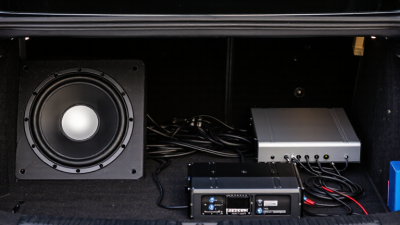
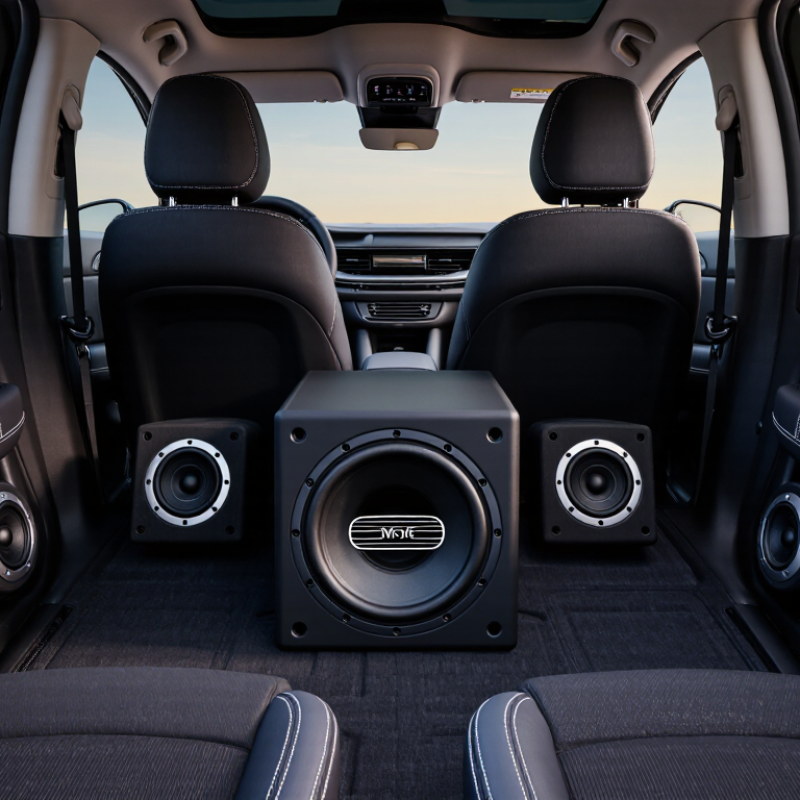
The luggage compartment is usually the most practical location. It provides space, safety, and useful cabin coupling. Secure the enclosure firmly. A loose box can rattle like a metal toolbox. Start with the subwoofer facing the rear seats, then test the opposite direction. Different cabins produce different peaks.

Set the low-pass crossover between 70 and 90 Hz. This range follows common professional bass-management guidance. Begin near 80 Hz, then listen for a smooth handoff. Set the phase to 0 degrees first. Switch to 180 degrees if bass becomes stronger at the driver’s seat. Adjust gain with familiar recordings, not maximum volume. The Audio Engineering Society’s automotive sound research emphasizes measurement because cabin reflections can exaggerate certain frequencies. A phone microphone can reveal problems, but it is not laboratory equipment. I once increased gain to hide weak door speakers. The result sounded louder, not better. Leave some headroom. Protect clarity.